
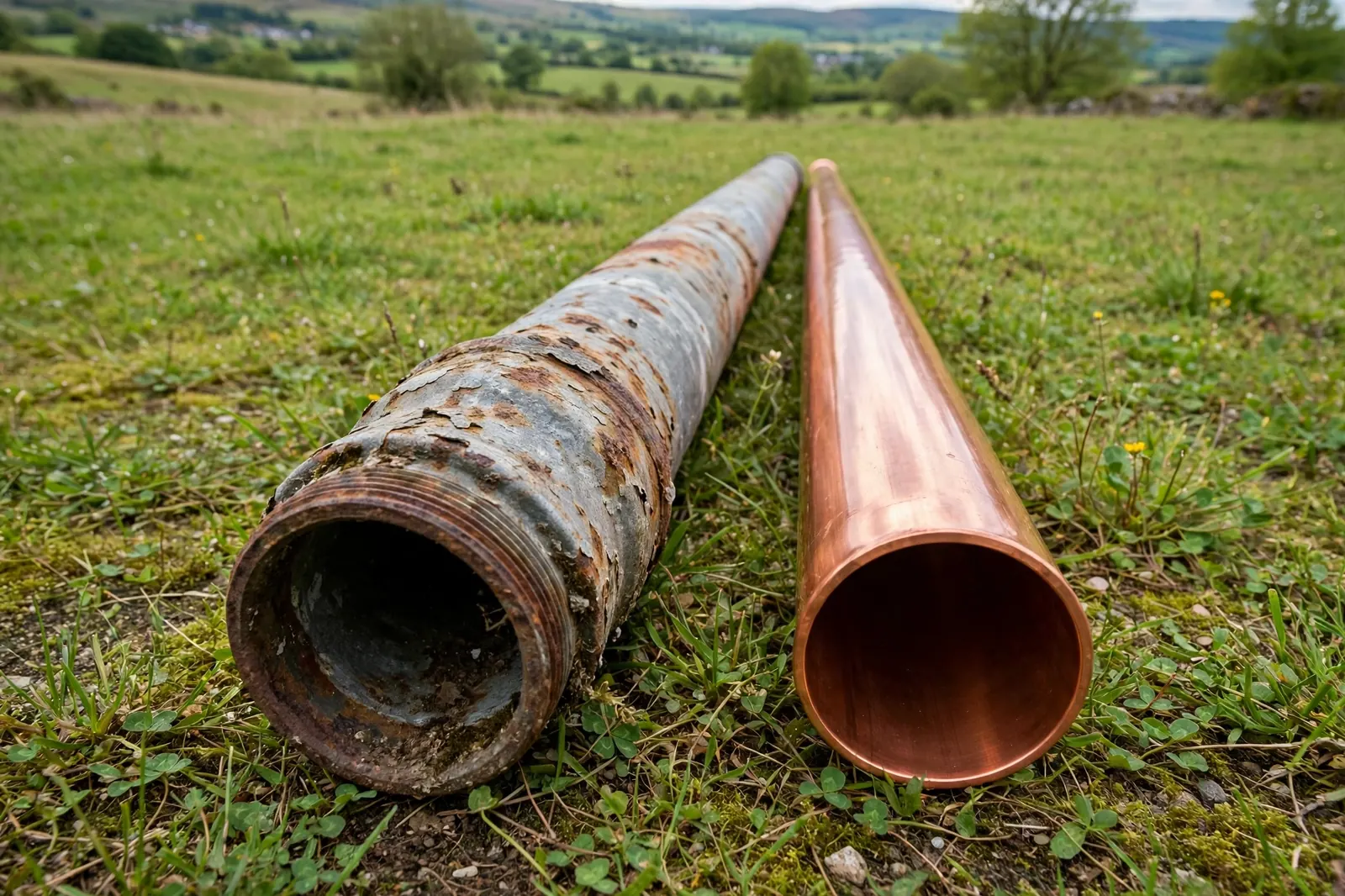
When a water service line leaks, the first question is whether to repair it or replace it. A repair is smaller and quicker. A replacement ends the problem for good. The right answer depends on the pipe — its material, its age, and how far the damage has gone — and this guide explains how a provider decides, what the two materials offer, and the Ohio law that helps with lead lines.
When a spot repair is enough
A spot repair makes sense when the damage is limited to one section and the rest of the line is sound. A single split from ground movement, or one joint that has failed, is a repair: the damaged section is cut out, new pipe and fittings are installed, and the line is tested. The digging is limited to the marked section, and the line is back in service quickly.
A spot repair is the right answer for a newer line with one clear problem, and for a line that has never failed before. It is also the answer when the pipe itself is in good condition — the material is sound, the joints are tight, and the leak is an isolated event rather than a symptom. Your provider will show you the pipe when it is exposed, so the decision is based on what is actually there.
When the line has had enough
A line that has leaked more than once has told you what it needs. Each repair fixes one section, and the next leak opens in the section beside it, because the whole line is failing at once. The same is true of a line that has corroded through its length: the pipe is thin everywhere, and patching one spot leaves the rest to fail.
Low water pressure is another sign. Internal corrosion narrows a galvanized line over time, and the pressure drops across the whole house. A repair cannot fix that, because the problem is the pipe itself, not one section of it. When the line has failed repeatedly, or the pressure has fallen because the pipe is narrowing, replacement is the answer.
Lead lines: replacement is the answer
A lead service line should not stay in the ground, and replacement is the only answer for one. Lancaster homes built before 1970 often still have lead lines, and the longer they stay, the more they should be replaced rather than repaired — a repair leaves the lead in place, and the next leak will come from the same pipe.
Ohio law helps here. Under Ohio Revised Code 4909.174, in effect since March 20, 2026, water-works companies must reimburse customers who replace a customer-owned lead service line, when the line is confirmed as lead or ordered replaced and the request is made within twelve months of completion. If your line is lead, ask your provider about the reimbursement before the work begins.
Copper or PEX?
The pipe used for replacement is modern copper or PEX — the two standard materials for service lines today. Copper has been the standard for generations: rigid, durable, and familiar in older Lancaster homes. Its main weakness is corrosion in aggressive soil and water, which is exactly what wears out old galvanized lines.
PEX is a flexible plastic pipe that has become standard for new work. It resists scale and corrosion, it bends around obstacles without joints, and it tolerates ground movement — useful in central Ohio clay soils that swell and shrink. Either material, installed well, will outlast the line it replaces. Your provider will recommend the one that fits your soil, your run, and your home.
What replacement involves
Replacement starts with an assessment: the material and condition of the existing line, the route it takes, and the access to it. Then the old line is removed and new pipe is laid along the route, with new fittings and a shutoff valve where the line enters the house. The new line is pressure-tested, the trench is backfilled, and the findings are explained.
The work is bigger than a spot repair — a longer trench, more pipe, more time — but it is one job instead of many. A replaced line ends the cycle of repeat leaks, restores full water pressure, and removes lead from the property where a lead line was in place.
How to decide
The decision comes from the assessment, not from a rule. A provider who has seen the pipe can tell you whether the damage is limited to one section or runs through the line, whether the material is sound or corroded, and whether the line is lead. Those three facts decide it: one section, sound material, no lead — repair. Repeated failures, corrosion through the line, or lead — replace.
Cost factors follow the same split. A spot repair is a smaller job; a replacement is a bigger one. But repeat repairs add up, and a replacement ends them. Your provider will explain the cost factors for your property after the line is located, before any work is agreed, so the decision is yours — made with the pipe in front of you.
What about the rest of the plumbing?
The service line is only the outside run — from the street main to the house. Inside the house, the plumbing is a separate system, with its own pipes, fixtures, and problems. A service line replacement does not touch the inside plumbing, and an inside leak does not mean the service line is failing. The assessment looks at the connection point, where the line enters the house, because that is where the two systems meet.
That boundary matters for the decision. If the inside plumbing is sound and the service line is failing, the work stays outside. If the inside lines are also aging, the provider will say so — but the service line work is still judged on its own: the material, the age, and the failures of the outside run. One job at a time, decided on the evidence for that job.
Related services and areas
Related services: Water Line Replacement & Repiping, Water Service Line Leak Repair. This guide applies across Lancaster, including Lancaster Camp Ground and all Lancaster neighbourhoods. Also read the blog index for more guides.
Questions, answered
Is replacement always more expensive than repair?
It depends on the job. A spot repair is a smaller job than a full replacement, but repeat repairs add up — and a line that keeps failing will keep needing them. Your provider will explain the cost factors for both options after the line is located.
How long does a new service line last?
A new copper or PEX line, installed well, will outlast the line it replaces by a wide margin. The material resists the corrosion that wore out the old galvanized or lead pipe, and the new line starts with a clean record.
Can I replace only part of the line?
Yes. A section replacement is possible where the rest of the line is sound. Full replacement is for lines that have failed throughout, corroded through, or are made of lead.
Will replacement disturb my driveway or garden?
It depends on the route of the line. A line under open lawn is the easiest to reach; a line under a driveway or a patio needs the surface opened and put back. Your provider will explain the access for your line and how the ground will be left afterwards, before any work begins.